Going to the movies is not what it used to be, and the steady demand for home theaters suggests a lot of people agree. Before you start planning one, it helps to settle a definition, because the two rooms people ask us about are different projects with different budgets.
For us the dividing line is the screen. A home theater is a dedicated, light-controlled room built around a projector and screen, with surround sound and seating arranged for one purpose. A media room is a living space that also happens to have excellent audio and video: a large television, good sound, comfortable furniture, and the lights on. Both can be superb. The right one depends on the room you have and how you actually live.
The dedicated home theater
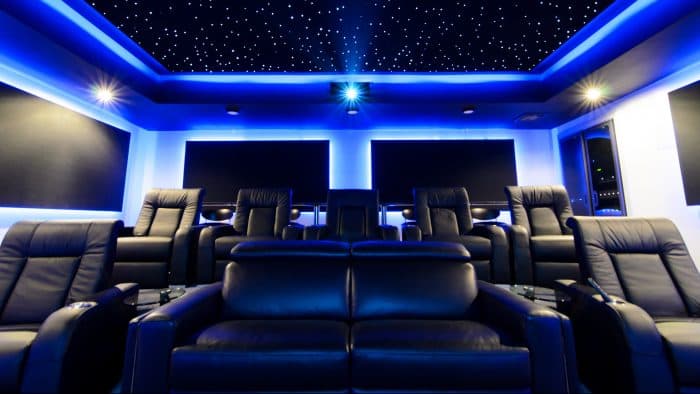
Projection needs darkness, which is why basements, bonus rooms, and converted bedrooms make the best theaters. Once the light is under control, a projector delivers an image size no television can match at a comparable price, and the room can be designed around it: tiered seating so every row has a clear view, acoustic treatment so dialogue stays intelligible, and a speaker layout, often Dolby Atmos with overhead channels, that puts sound where the picture says it should be.
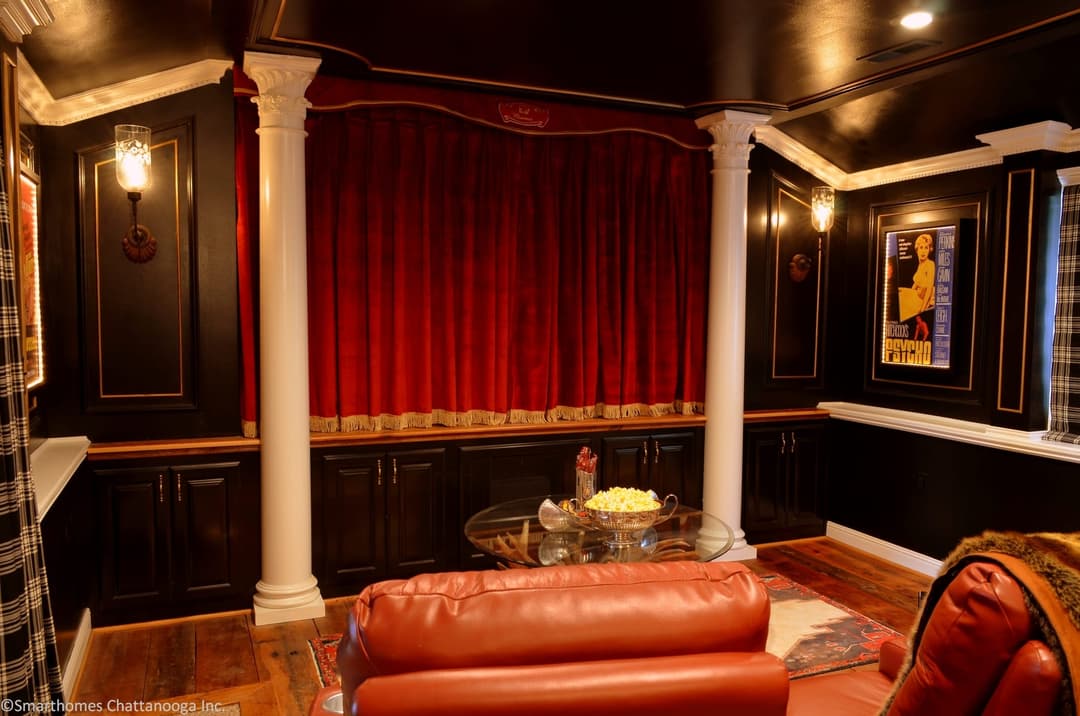
Two changes have made theaters easier to build well. Laser projectors have replaced lamps, so brightness stays consistent for years without bulb changes. And ambient-light-rejecting screens let a projected image hold up with a few lights on, which makes the room more usable for a game or a party. Our tiered private theater and this basement theater show what the finished room looks like; the anamorphic theater goes a step further with a wide cinema-format screen.
The media room
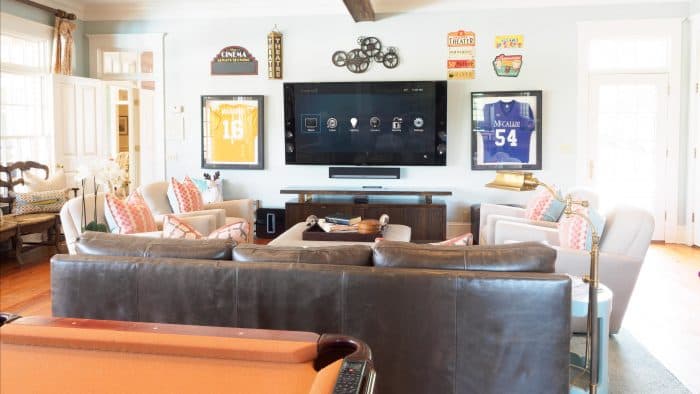
A media room starts from the opposite premise: the family already uses this space, and the technology has to fit into it. That usually means a television rather than a projector, because a TV looks great with the blinds open and needs no special room. Televisions in the 85-to-100-inch range are now realistic for a family room, and OLED and high-end LCD panels handle bright rooms without complaint. Sound can still be immersive, with in-wall or in-ceiling speakers that disappear into the architecture, or a discreet soundbar system where a full speaker layout is not practical.
Media rooms are also where the interesting hybrids live. An ultra-short-throw laser projector paired with an ambient-light-rejecting screen can put a 120-inch image on a living room wall. A golf simulator shares a projector and screen with movie night. A whole-home system lets the same sources play in the media room, the porch, and the theater.
How to choose
- Which room? If you have a space you can darken and dedicate, a theater is possible. If the room has to serve as a family room, start with a media room.
- What do you watch? Films and series reward a theater. Sports, gaming, and background television are happier in a media room where people can talk and move around.
- How many people? A theater seats a fixed number very well. A media room flexes for a crowd.
- Acoustics. Hard floors and big windows are the enemy of clear dialogue. A theater can be treated; a media room needs speaker placement and processing that work around the decor.
- Budget. A theater is a construction project as much as an electronics project. A media room can be built in stages.
Either way, the mistakes are the same: a screen that is the wrong size for the seating distance, speakers placed where they fit rather than where they work, and a control system added as an afterthought. Design first, then buy. Our home theater team handles both kinds of rooms, and a conversation about your space is the best place to start.